Learning how you best study is just as important as getting a jump on the material!
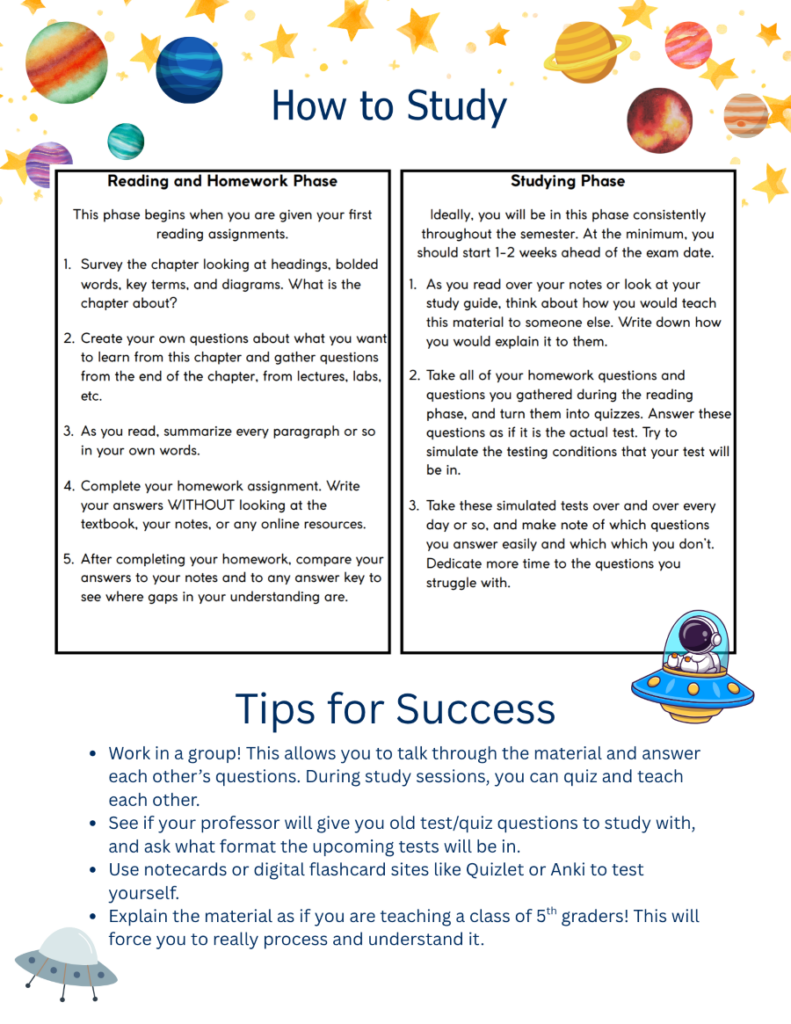
How to Study
Reading and Homework Phase – this phase begins when you receive your first assignment.
- Survey the chapter looking at headings, bolded words, key terms, and diagrams. What is thechapter about?
- Create your own questions about what you want to learn from this chapter and gather questions from the end of the chapter, from lectures, labs, etc.
- As you read, summarize every paragraph or so in your own words.
- Complete your homework assignment. Write your answers WITHOUT looking at the textbook, your notes, or any online resources.
- After completing your homework, compare your answers to your notes and to any answer key to see where gaps in your understanding are.
Studying Phase – Ideally, you will be in this phase consistently throughout the semester. At the minimum, you should start 1-2 weeks ahead of the exam date.
- As you read over your notes or look at your study guide, think about how you would teach this material to someone else. Write down how you would explain it to them.
- Take all of your homework questions and questions you gathered during the reading phase, and turn them into quizzes. Answer these questions as if it is the actual test. Try to simulate the testing conditions that your test will
be in. - Take these simulated tests over and over every day or so, and make note of which questions you answer easily and which which you don’t. Dedicate more time to the questions you struggle with.
Tips for Success
- Work in a group! This allows you to talk through the material and answer each other’s questions. During study sessions, you can quiz and teach each others.
- See if your professor will give you old test/quiz questions to study with, and ask what format the upcoming tests will be in.
- Use notecards or digital flashcard sites like Quizlet or Anki to test yourself.
- Explain the material as if you are teaching a class of 5th graders! This will force you to really process and understand it.
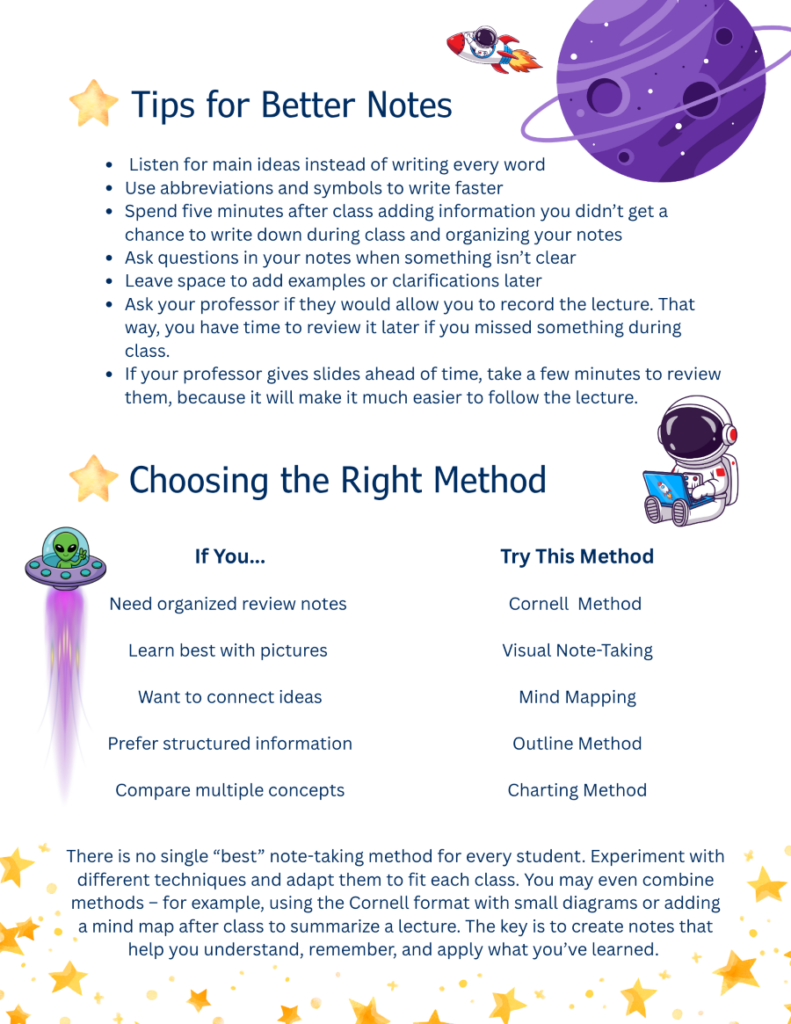
Tips for Better Notes
- Listen for main ideas instead of writing every word
- Use abbreviations and symbols to write faster
- Spend five minutes after class adding information you didn’t get a chance to write down during class and organizing your notes
- Ask questions in your notes when something isn’t clear
- Leave space to add examples or clarifications later
- Ask your professor if they would allow you to record the lecture. That way, you have time to review it later if you missed something during class.
- If your professor gives slides ahead of time, take a few minutes to review them, because it will make it much easier to follow the lecture.
Choosing the Right Study Method
- Need organized review notes – Cornell Method
- Learn best with pictures – Visual Note-Taking
- Want to connect ideas – Mind Mapping
- Prefer structured information – Outline Method
- Compare multiple concepts – Charting Method
There is no single “best” note-taking method for every student. Experiment with different techniques and adapt them to fit each class. You may even combine methods – for example, using the Cornell format with small diagrams or adding a mind map after class to summarize a lecture. The key is to create notes that help you understand, remember, and apply what you’ve learned.
Note Taking – it may look different between various disciplines.
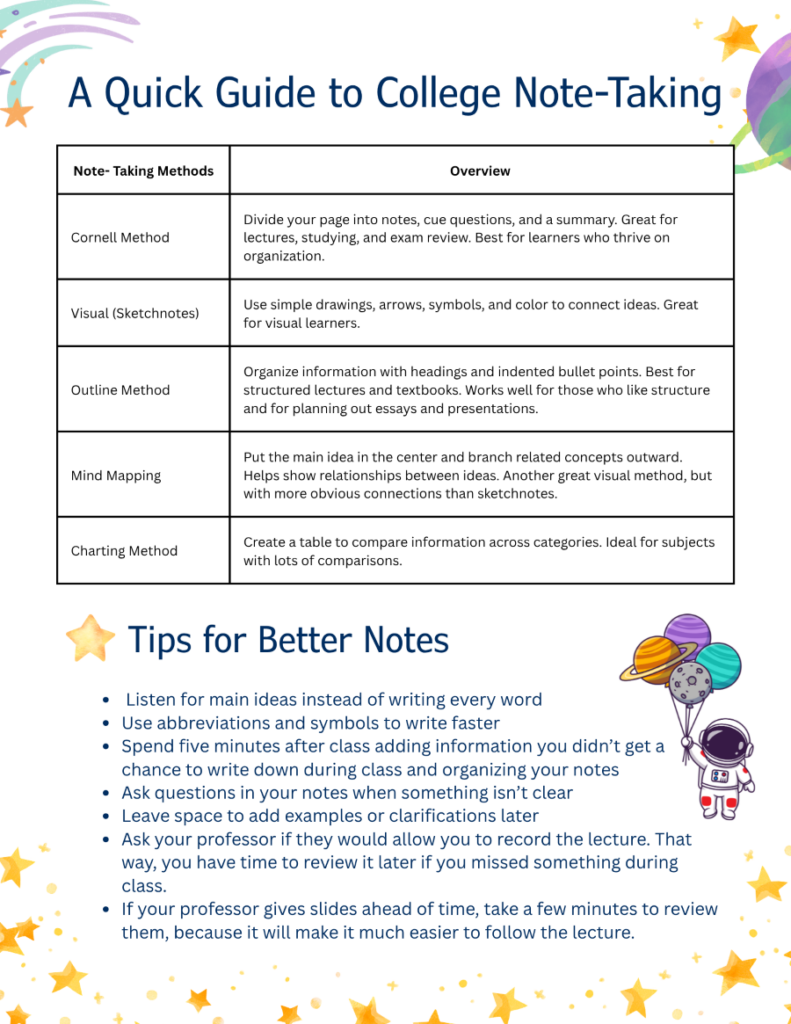
A Quick Guide to College Note-Taking
| Note- Taking Methods | Overview |
| Cornell Method | Divide your page into notes, cue questions, and a summary. Great for lectures, studying, and exam review. Best for learners who thrive on organization. |
| Visual (Sketchnotes) | Use simple drawings, arrows, symbols, and color to connect ideas. Great for visual learners. |
| Outline Method | Organize information with headings and indented bullet points. Best for structured lectures and textbooks. Works well for those who like structure and for planning out essays and presentations. |
| Mind Mapping | Put the main idea in the center and branch related concepts outward. Helps show relationships between ideas. Another great visual method, but with more obvious connections than sketchnotes. |
| Charting Method | Create a table to compare information across categories. Ideal for subjects with lots of comparisons. |
Tips for Better Notes
- Listen for main ideas instead of writing every word
- Use abbreviations and symbols to write faster
- Spend five minutes after class adding information you didn’t get a chance to write down during class and organizing your notes
- Ask questions in your notes when something isn’t clear
- Leave space to add examples or clarifications later
- Ask your professor if they would allow you to record the lecture. That way, you have time to review it later if you missed something during class.
- If your professor gives slides ahead of time, take a few minutes to review them, because it will make it much easier to follow the lecture.
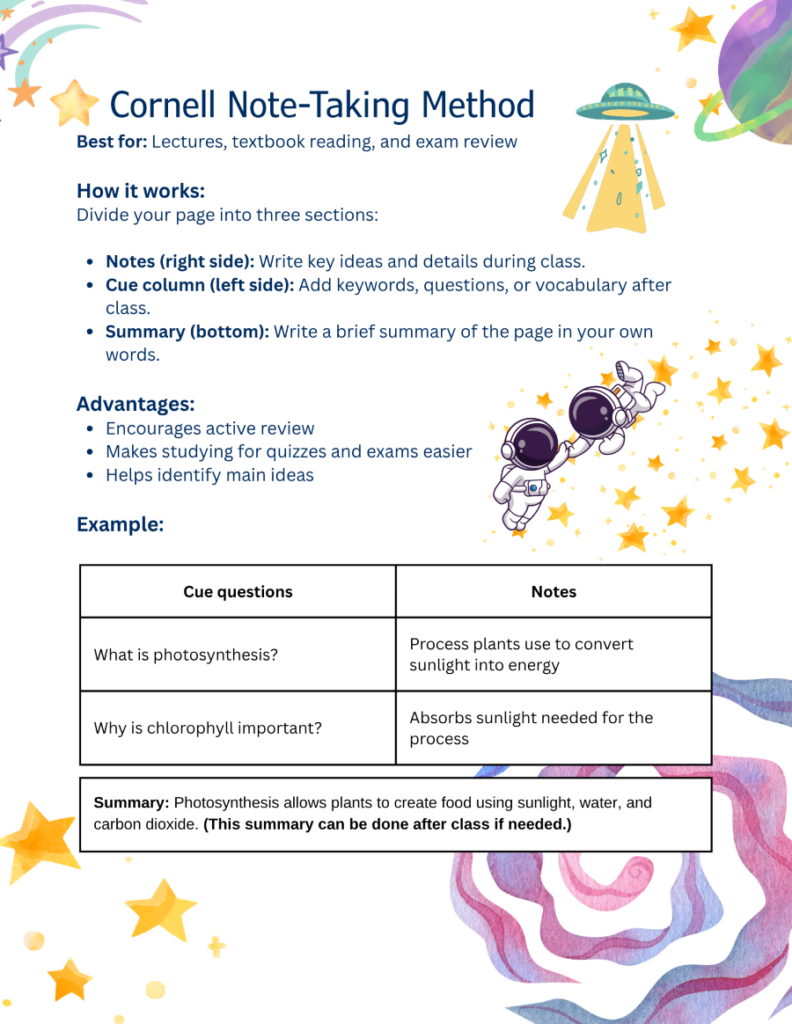
Cornell Note-Taking Method
Best for: Lectures, textbook reading, and exam review
How it works: Divide your page into three sections.
- Notes (right side): Write key ideas and details during class.
- Cue column (left side): Add keywords, questions, or vocabulary after class.
- Summary (bottom): Write a brief summary of the page in your own words.
Advantages: Encourages active review Makes studying for quizzes and exams easier Helps identify main ideas.
Example Cue questions – What is photosynthesis? Why is chlorophyll important?
Example Notes – Process plants use to convert sunlight into energy. Absorbs sunlight needed for the process.
Example Summary – Photosynthesis allows plants to create food using sunlight, water, and carbon dioxide. (This summary can be done after class if needed.)
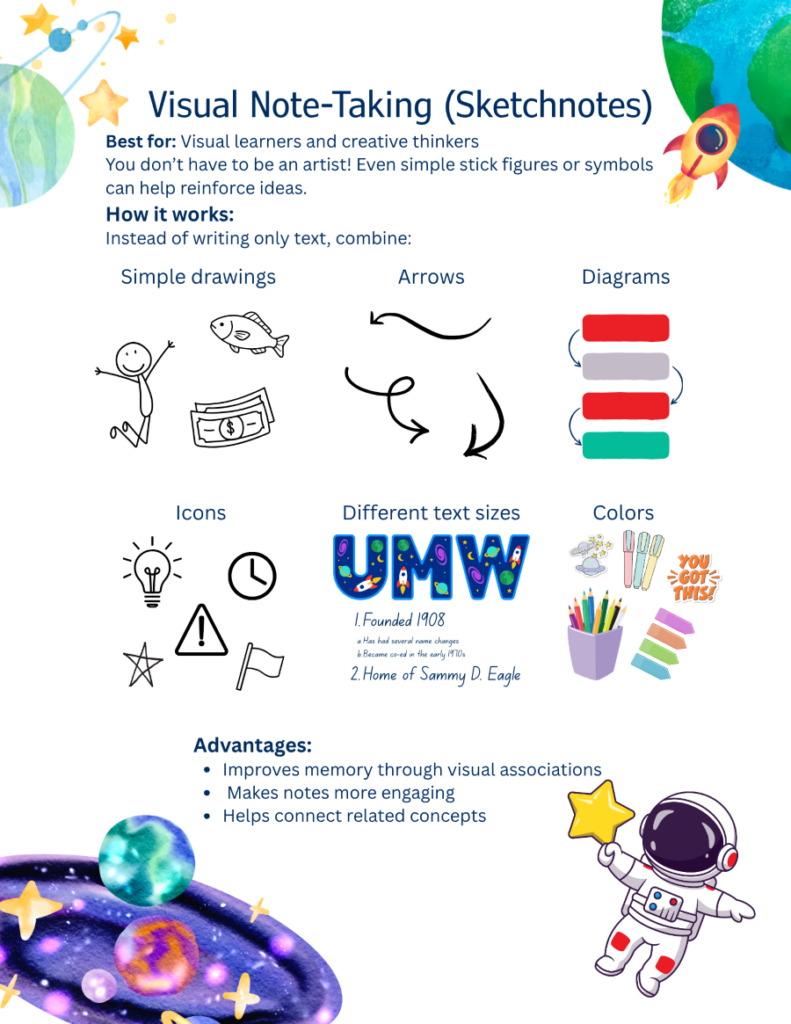
Visual Note-Taking (Sketchnotes)
Best for: Visual learners and creative thinkers You don’t have to be an artist!
Even simple stick figures or symbols can help reinforce ideas.
How it works: Instead of writing only text, combine: simple drawings, arrows, diagrams, icons, different text sizes, and colors.
Advantages: Improves memory through visual associations Makes notes more engaging Helps connect related concepts.
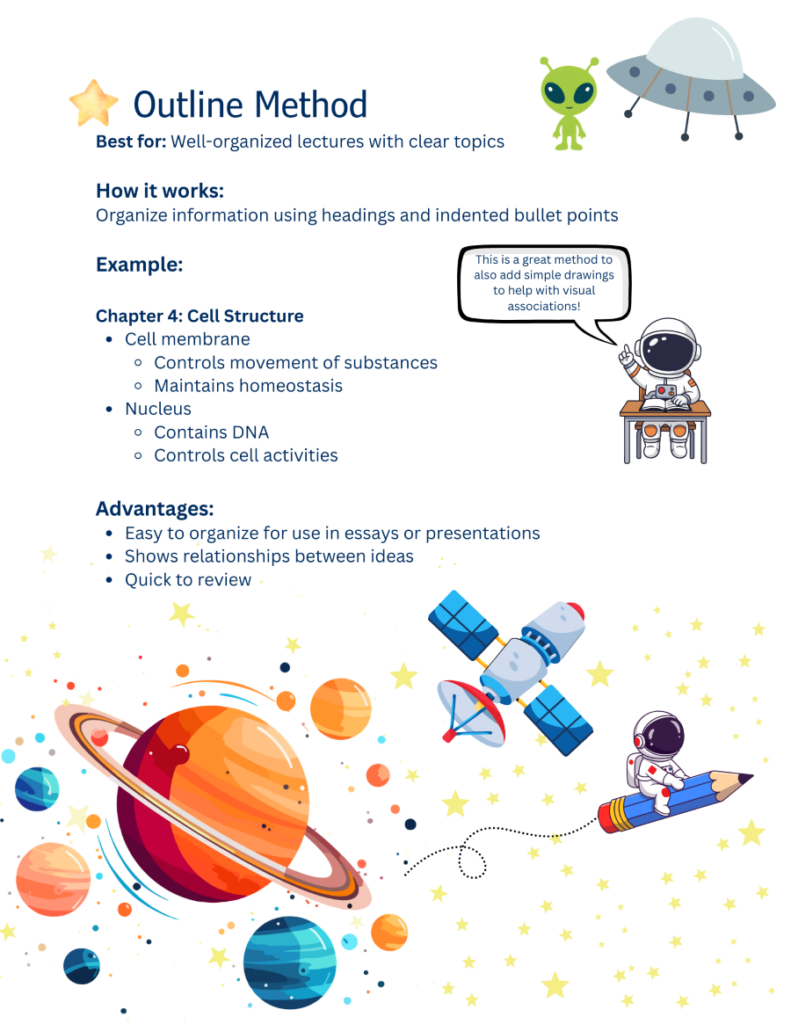
Outline Method
Best for: Well-organized lectures with clear topics.
How it works: Organize information using headings and indented bullet points.
Example: Chapter 4 – Cell Structure
- Cell membrane
- Controls movement of substances
- Maintains homeostasis
- Nucleus
- Contains DNA
- Controls cell activities
Advantages: Easy to organize for use in essays or presentations, shows relationships between ideas, and quick to review.
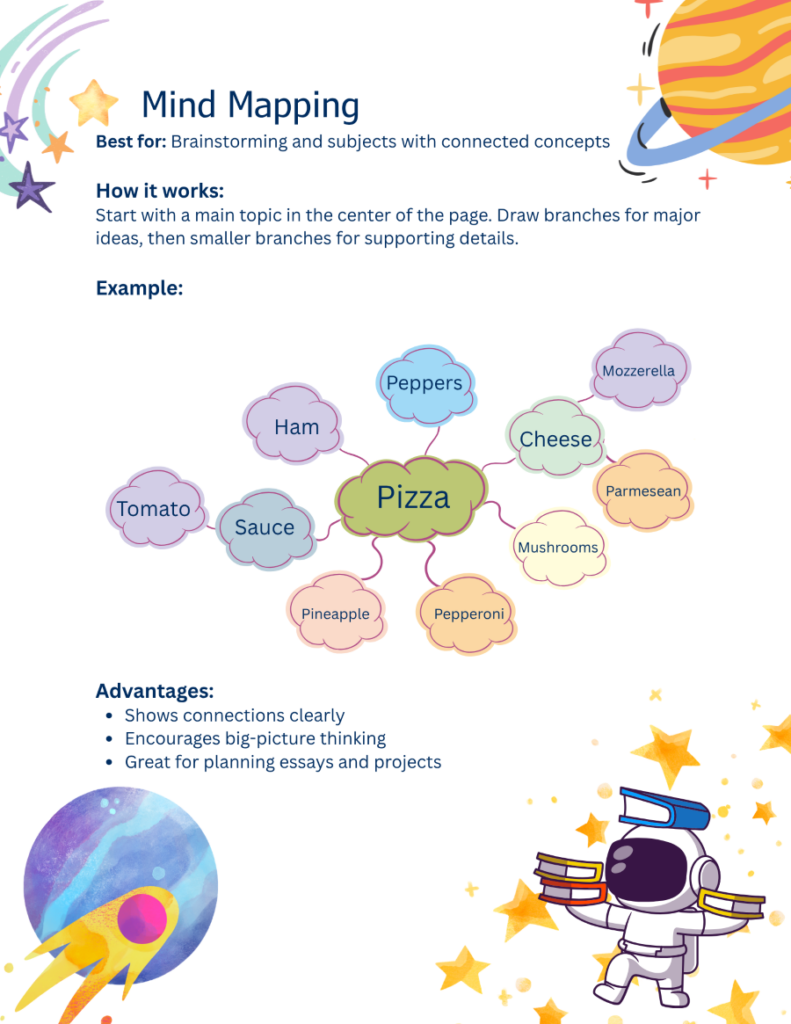
Mind Mapping
Best for: Brainstorming and subjects with connected concepts
How it works: Start with a main topic in the center of the page. Draw branches for major ideas, then smaller branches for supporting details.
Advantages: Shows connections clearly, encourages big-picture thinking, great for planning essays and projects.
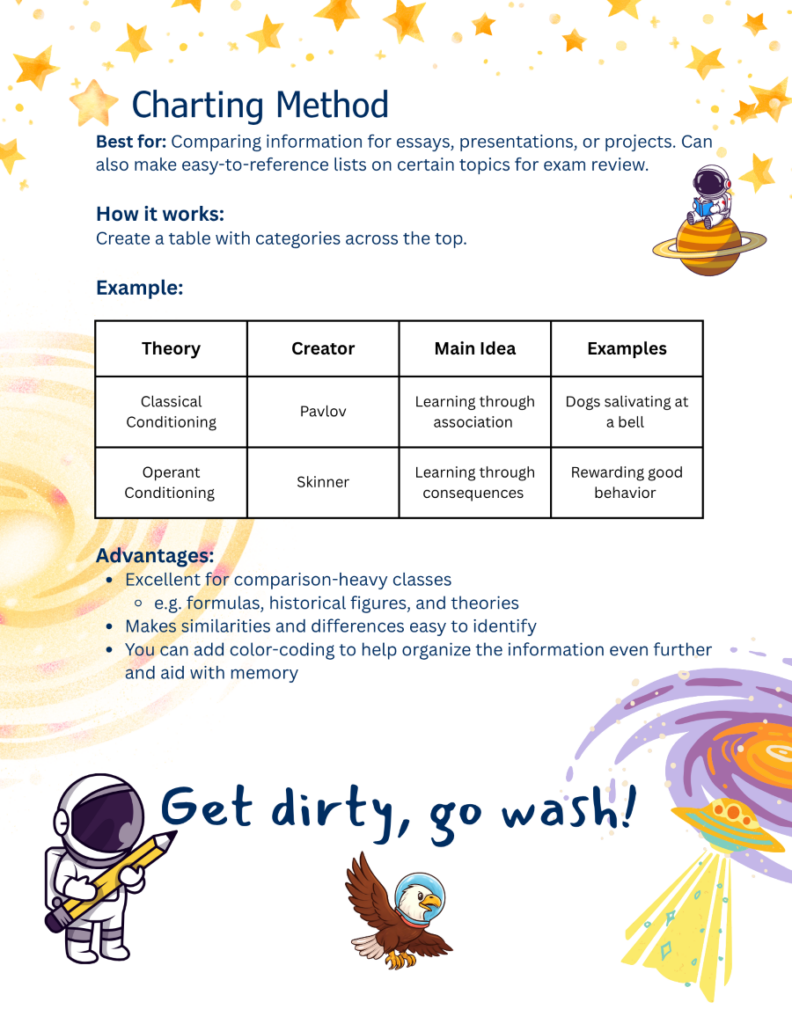
Charting Method
Best for: Comparing information for essays, presentations, or projects. Can also make easy-to-reference lists on certain topics for exam review.
How it works: Create a table with categories across the top.
Example:
| Theory | Creator | Main Idea | Examples |
| Classical Conditioning | Pavlov | Learning through association | Dogs salivating at a bell |
| Operant Conditioning | Skinner | Learning through consequences | Rewarding good behavior |
Advantages: Excellent for comparison-heavy classes e.g. formulas, historical figures, and theories. Makes similarities and differences easy to identify. You can add color-coding to help organize the information even further and aid with memory.
