Morning and Evening Routines
Pick a morning ritual that will make your more productive. Or work towards a mindful morning routine.
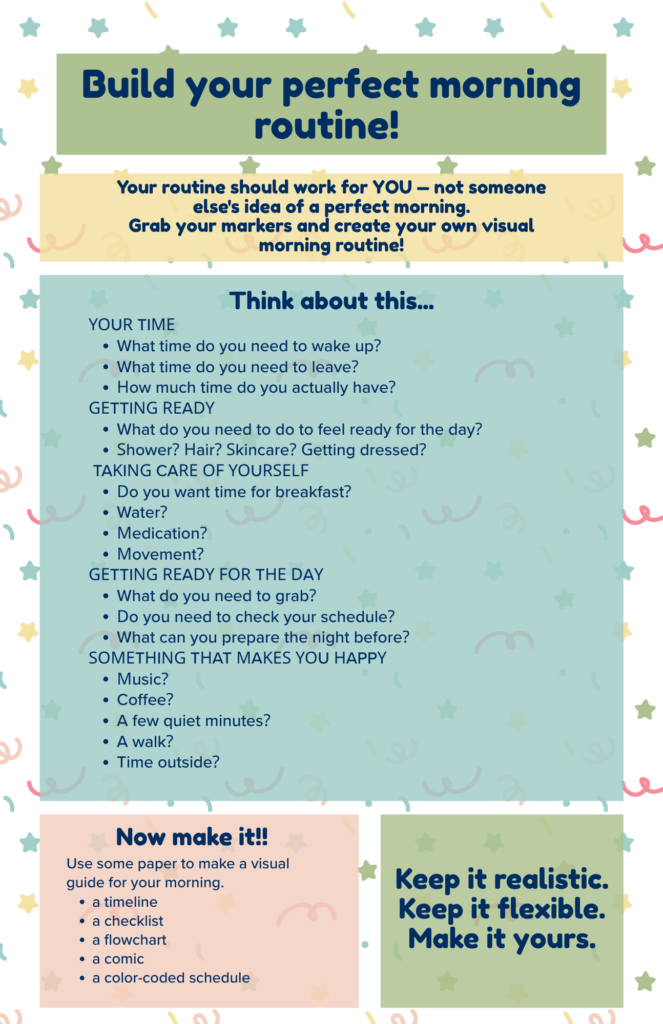
Build your perfect morning routine!
Your routine should work for YOU — your nighttime routine should help you wind down + make tomorrow easier.
OUR TIME
- What time do you need to wake up?
- What time do you need to leave?
- How much time do you actually have?
GETTING READY
- What do you need to do to feel ready for the day?
- Shower? Hair? Skincare? Getting dressed?
TAKING CARE OF YOURSELF
- Do you want time for breakfast?
- Water?
- Medication?
- Movement?
GETTING READY FOR THE DAY
- What do you need to grab?
- Do you need to check your schedule?
- What can you prepare the night before?
SOMETHING THAT MAKES YOU HAPPY
- Music?
- Coffee?
- A few quiet minutes?
- A walk?
- Time outside?
Now you Make It!
- a timeline
- a checklist
- a flowchart
- a comic
- a color-coded schedule
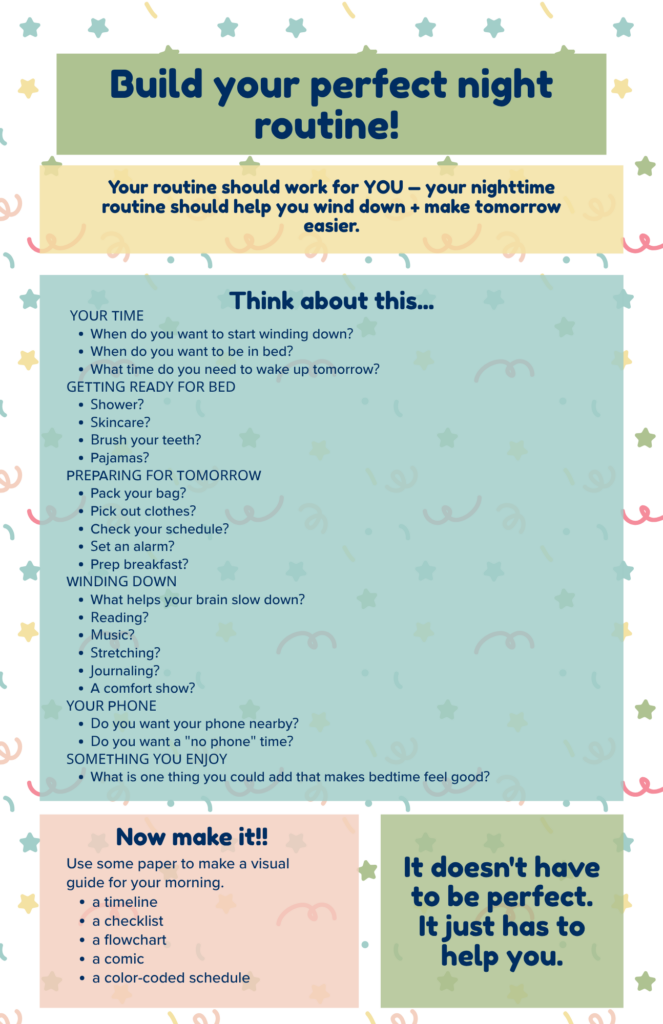
Build your perfect night routine!
YOUR TIME
- When do you want to start winding down?
- When do you want to be in bed?
- What time do you need to wake up tomorrow?
GETTING READY FOR BED
- Shower?
- Skincare?
- Brush your teeth?
- Pajamas?
PREPARING FOR TOMORROW
- Pack your bag?
- Pick out clothes?
- Check your schedule?
- Set an alarm?
- Prep breakfast?
WINDING DOWN
- What helps your brain slow down?
- Reading?
- Music?
- Stretching?
- Journaling?
- A comfort show?
YOUR PHONE
- Do you want your phone nearby?
- Do you want a “no phone” time?
SOMETHING YOU ENJOY
- What is one thing you could add that makes bedtime feel good?
Use some paper to make a visual guide for your morning.
Now you Make It!
- a timeline
- a checklist
- a flowchart
- a comic
- a color-coded schedule
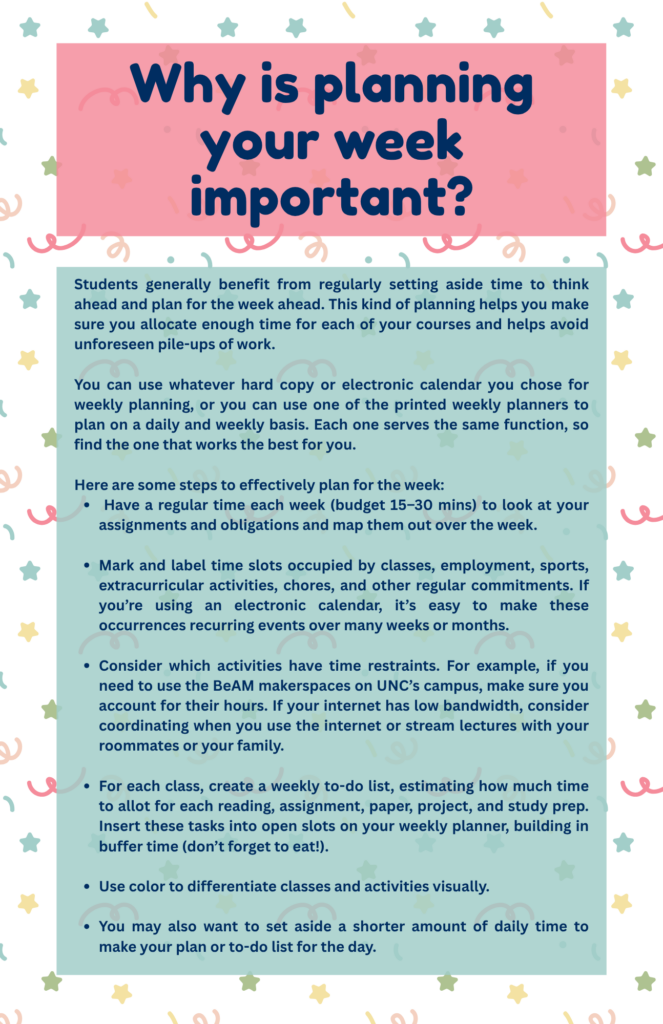
Students generally benefit from regularly setting aside time to think ahead and plan for the week ahead. This kind of planning helps you make sure you allocate enough time for each of your courses and helps avoid unforeseen pile-ups of work.
You can use whatever hard copy or electronic calendar you chose for weekly planning, or you can use one of the printed weekly planners to plan on a daily and weekly basis. Each one serves the same function, so find the one that works the best for you.
Here are some steps to effectively plan for the week:
- Have a regular time each week (budget 15–30 mins) to look at your assignments and obligations and map them out over the week.
- Mark and label time slots occupied by classes, employment, sports, extracurricular activities, chores, and other regular commitments. If you’re using an electronic calendar, it’s easy to make these occurrences recurring events over many weeks or months.
- Consider which activities have time restraints. For example, if you need to use the makerspaces, make sure you account for their hours. If your internet has low bandwidth, consider coordinating when you use the internet or stream lectures with your roommates or your family.
- For each class, create a weekly to-do list, estimating how much time to allot for each reading, assignment, paper, project, and study prep. Insert these tasks into open slots on your weekly planner, building in buffer time (don’t forget to eat!).
- Use color to differentiate classes and activities visually.
- You may also want to set aside a shorter amount of daily time to make your plan or to-do list for the day.
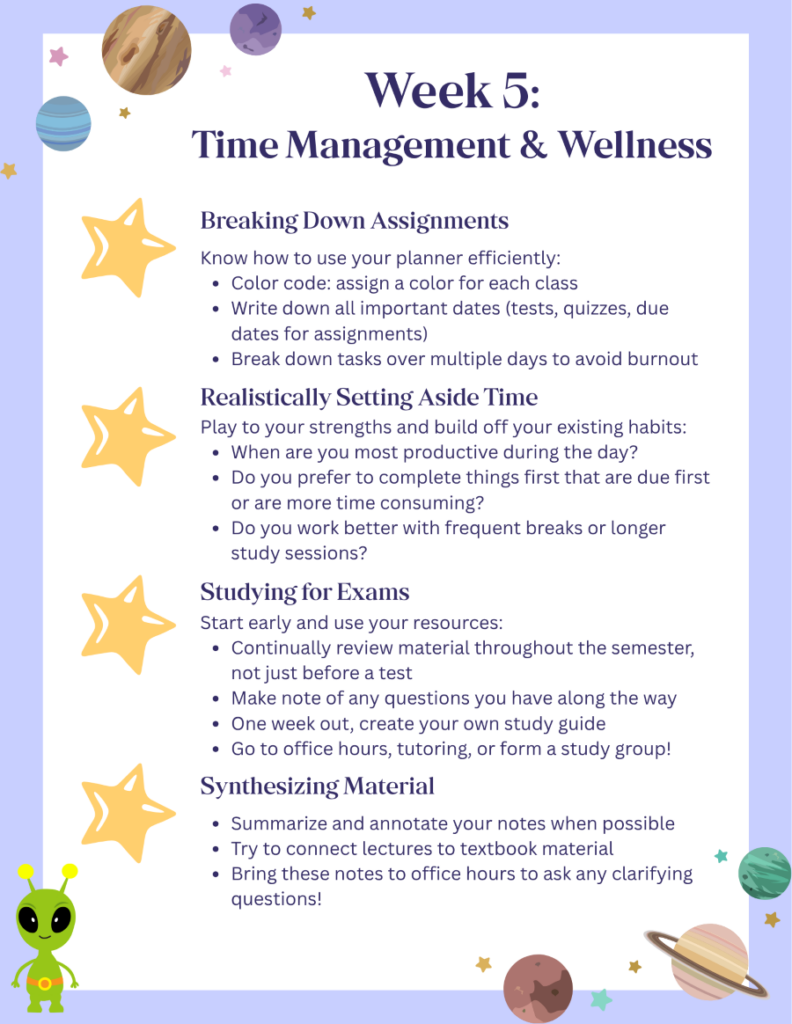
Week 5: Time Management & Wellness
- Breaking Down Assignments: Know how to use your planner efficiently:
- Color code: assign a color for each class
- Write down all important dates (tests, quizzes, due dates for assignments)
- Break down tasks over multiple days to avoid burnout
- Realistically Setting Aside Time: Play to your strengths and build off your existing habits
- When are you most productive during the day?
- Do you prefer to complete things first that are due first or are more time consuming?
- Do you work better with frequent breaks or longer study sessions?
- Studying for Exams Start: early and use your resources
- Continually review material throughout the semester, not just before a test
- Make note of any questions you have along the way
- One week out, create your own study guide
- Go to office hours, tutoring, or form a study group!
- Synthesizing Material
- Summarize and annotate your notes when possible
- Try to connect lectures to textbook material
- Bring these notes to office hours to ask any clarifying questions!
